

30-Second Perspectives — Series #4
Response & Accountability: Turning AI Exposure into Durable Operating Advantage
In the first three parts of this series, we traced a familiar pattern in enterprise AI adoption.
In Series #1, we established that AI readiness is not feature readiness. It is an operating posture defined by discipline, ownership, and data fitness.
In Series #2, we examined how AI functions as a live diagnostic, exposing enterprise integrity in real time.
In Series #3, we confronted why many organizations stall, caught between insight and action as leadership friction, governance gaps, and unresolved decision rights slow progress.
Series #4 is about what comes next.
Because once AI exposure is visible, inaction becomes a choice.
The Leadership Shift That Matters
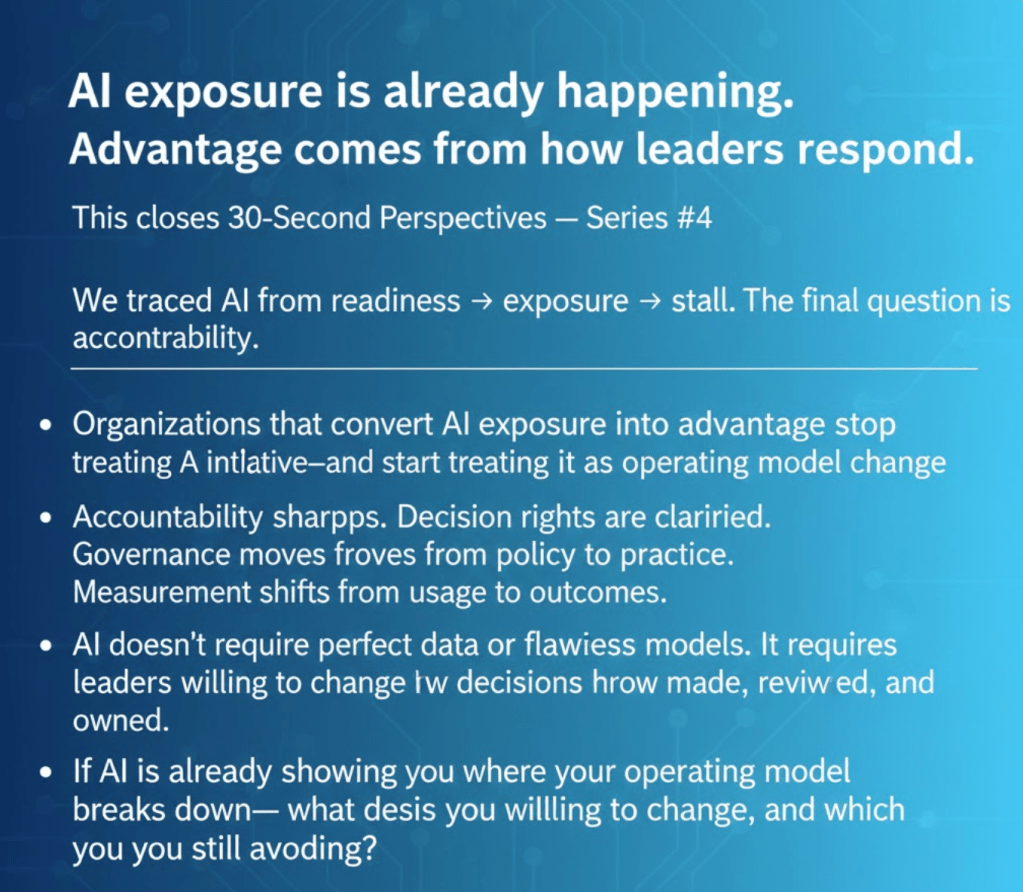
Organizations that convert AI exposure into advantage make a clear shift: they stop treating AI as a technology initiative and start treating it as an operating model change.
This is where accountability sharpens.
Decision rights are clarified. Ownership is named and enforced. Governance moves from policy to practice. Measurement shifts from feature adoption to outcome quality.
AI doesn’t need perfect data or flawless models to create value. It requires leaders willing to change how decisions are made, reviewed, and improved.
What High-Maturity Organizations Do Differently
Organizations that go beyond pilots and headlines usually take the same steps.
- They establish clear platform and data ownership, with accountability that spans business and technology.
- They define decision pathways for how AI-supported insights are reviewed, challenged, and acted upon.
- They operationalize governance, embedding controls directly into workflows rather than relying on after-the-fact oversight.
- They invest in evaluation skills, ensuring teams can assess outputs, bias, and impact—not just model performance.
- They measure success by decision quality, cycle time, and trust, not by how often AI is used.
These aren’t AI best practices. They are leadership practices applied to AI.
Accountability Is the Multiplier
AI amplifies whatever operating model it encounters. When accountability is weak, AI accelerates risk. When accountability is clear, AI accelerates learning.
This is why the organizations seeing durable value are not the fastest adopters. They are the most deliberate operators.
They treat AI exposure as feedback.They respond with structural change.They revisit ownership, incentives, and governance before scaling further.
The Real Outcome
The goal is not AI maturity for its own sake. The goal is an organization that makes better decisions, faster, with greater confidence and transparency.
AI becomes an advantage only when leaders are willing to be accountable for what it reveals.
Leadership Question
If AI is already revealing where your operating model fails, which decisions are you willing to change, and which ones are you still avoiding?
Closing the Series
This series was designed to be read quickly, but thought about longer.
AI is no longer experimental. Exposure is already underway. The key difference is response.
The organizations that lead won’t be those with the most advanced models. They will be the ones with the courage and discipline to act on what AI reveals.

 SNC Development
You must be logged in to post a comment.